


There are many underground cities to visit in Cappadocia. In past ages, Cappadocia was a region that came under attack very frequently, and the peoples living here built underground cities as places of refuge to protect themselves. It is impossible to see the like of Cappadocia’s underground cities anywhere else, because these cities are suited only to Cappadocia’s geological structure.
Cappadocia is known to hold more than 200 underground cities, but not all of them have yet been discovered. The history of the underground cities is estimated to go back to the 4th century BC.
After you finish touring all these underground cities, you will need a good rest — and for that we recommend the MDC Hotel.
Derinkuyu Underground City
This is the largest underground city in Cappadocia. Built by the early Christians, this underground city reaches a depth of 85 meters.
It was discovered by chance in 1963 and opened to tourism in 1967. Derinkuyu (“deep well”) takes its name from the wells, some 60–70 meters deep, from which its drinking water was drawn.
Protected by various traps, the city’s entrance was designed to go unnoticed, and there are areas where people could live for long periods without ever leaving.
Derinkuyu Underground City is estimated to consist of 12 or 13 levels. Inside the city there are ventilation shafts, food stores, a monastery and churches, wineries, toilets, meeting rooms, and water wells. Derinkuyu is the most famous of the underground cities to visit in Cappadocia.
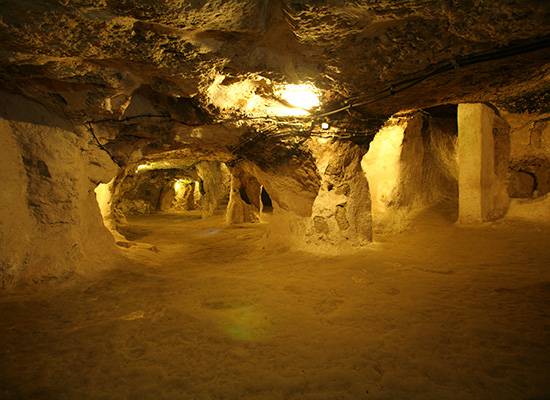
Kaymaklı Underground City
Built in the Hittite era, Kaymaklı Underground City has a history stretching back to 3000 BC. It consists of 8 levels and features massive sliding stone doors. It also contains grape-pressing rooms.
The city is known to have had a capacity of 5,000 people.
On the first level of the city there are stables, so that the inhabitants could meet their food needs from their animals.
Descending to the second level, you find a burial ground, a church, and baptismal fonts.
On the third level there are areas where they stored goods such as flour and wheat, wine cellars, a dining area, and grape-pressing rooms.
On the final level of the tour there is a very narrow tunnel, along with a kitchen, a tandoor oven, and a food store. This underground city hosted civilizations such as the Hittites, the Phrygians, and the Assyrians.
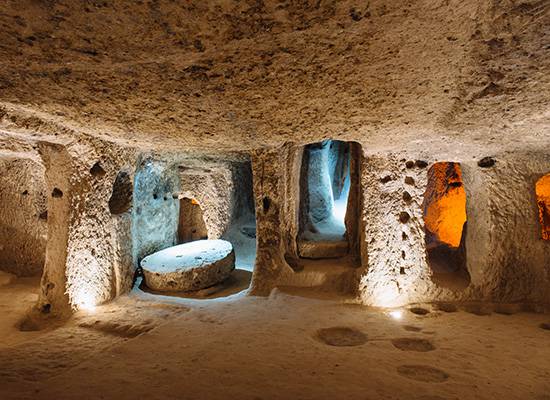
Gaziemir Underground City
This underground city is rather different from the others. The difference is that, unlike the other underground cities, it was not built for protection but rather for accommodation. Discovered in 2006, Gaziemir Underground City has a history going back to the Hittite era, but it was used most intensively in the Byzantine period.
It also differs from the other underground cities in structure. It lacks the narrow, deep tunnels seen in the others. It has a watchtower, and its entrance is quite comfortable. Inside there is an enormous grape-pressing room, together with the wine jars used to store the wines made there.
There are also two churches, hearths, a bath, tandoor ovens, a kitchen, food stores, and room-like resting areas.
Tatlarin Underground City
Discovered in 1975, Tatlarin Underground City opened its doors to visitors in 1991. It houses a great many churches, though most of them have unfortunately collapsed. Its entrance gate has likewise collapsed, so the underground city is entered through two different openings on its western side.
Although it covers quite a large area, only two of its levels can be toured. Looking at the interior of the city, it resembles a monastery complex or a military garrison more than an underground settlement.
Three skeletons were found in the section known as the dungeon. There is also a pantry, a kitchen, a toilet, and a Roman-era burial ground.
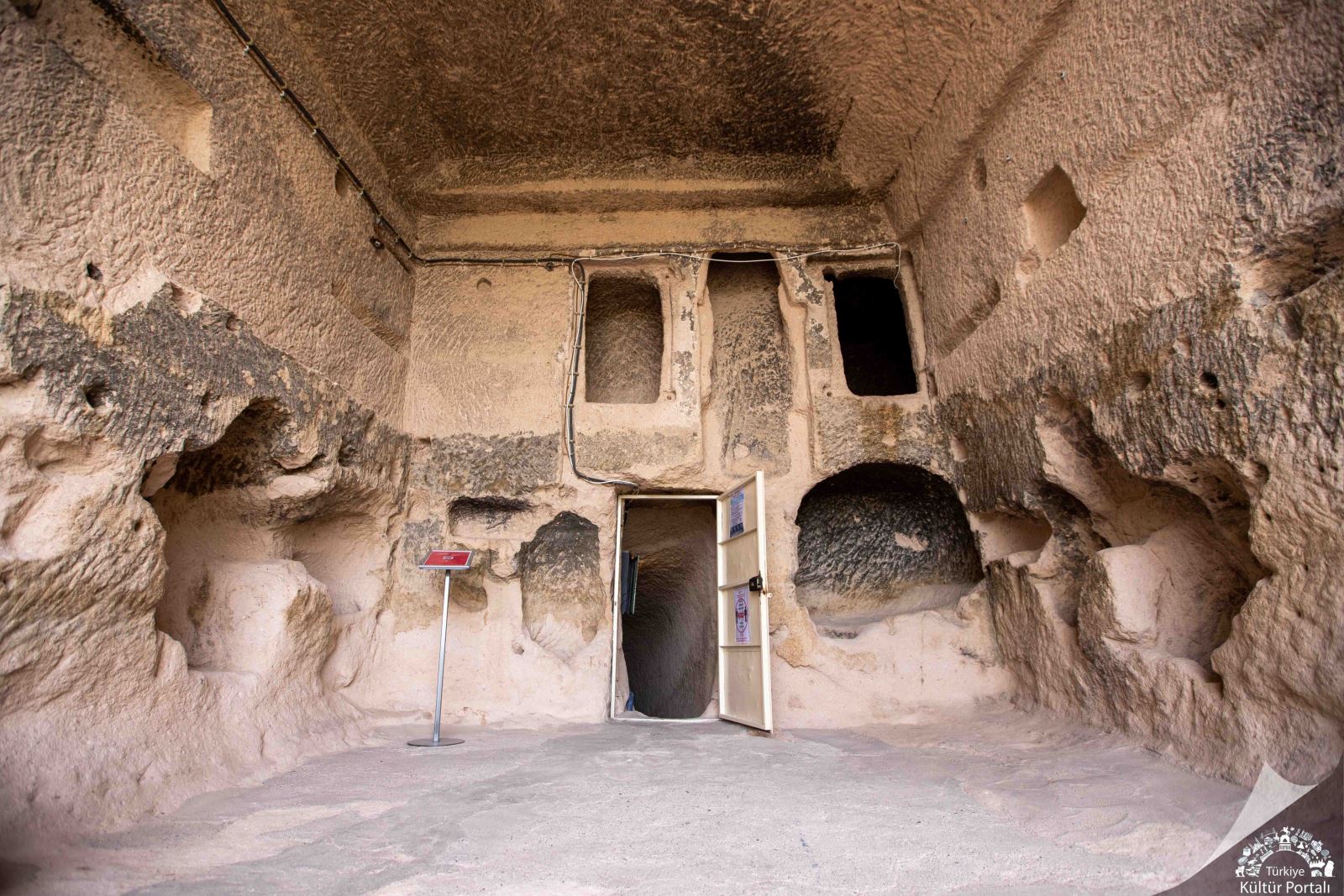
Özkonak Underground City
Although no precise date exists, this site is estimated to have been built in the 400s BC. Özkonak Underground City was turned into a living space where food could easily be preserved, and people were also permitted to shelter here. According to archaeologists, Özkonak Underground City was the seat of the local principalities of the Hittite era. It later became territory of the Persians and, in the Hellenistic period, of the Roman Empire. The Temple of Zeus is also located here. After the Roman period, the early Christians took refuge here, fleeing Byzantine oppression and Arab raids. Under the leadership of Saint Basil, the people carved into the rocks and founded a city of their own.
Mazı Underground City
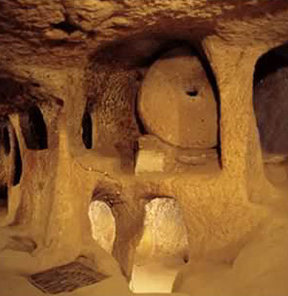
When we journey back to the Hellenistic period, we come upon Mazı Underground City. The history of its tombs and churches goes back 2,000 years. It hosted a succession of civilizations through the Phrygian, Lydian, and Byzantine eras. According to one account, the underground city’s name derives from the word “Mazata”, meaning “Ancient City”.
Four different entrances are used to enter Mazı Underground City, which consists of 8 levels.
There are stables on the entrance level of the city. Animal husbandry was the livelihood of this place, where an estimated 6,000 people lived.
There are also areas serving as storerooms, cellars, sitting areas, and baths.

